Spain’s new coalition government, led by the Socialist Party and Unidas Podemos It vows to strengthen job security and unions, raise the minimum wage and taxes on the wealthy, pass a climate-change law, and introduce free, universal public child car
By Sebastiaan Faber and Bécquer Seguín- January 9, 2020
Madrid — It felt like déjà vu. On December 30, when most of Spain was in the midst of a two-week holiday break, Socialist interim Prime Minister Pedro Sánchez and Unidas Podemos leader Pablo Iglesias found themselves again together in front of reporters in a room at the Palacio de las Cortes. It was the site where on November 12, two days after the general elections, they’d made the surprise announcement of a joint attempt to form a government. Following six weeks of negotiations, not only between the two parties but also with the Catalan Left Republicans (ERC) and the Basque Nationalist Party (PNV), the Socialists and Podemos presented a 50-page document outlining 11 points of emphasis for how the new “progressive coalition” would govern Spain.
Sánchez and Iglesias’s parties only hold 155 seats in parliament, 21 short of an absolute majority. Yet on Tuesday, after two days of rowdy debate, they were backed by a razor-thin simple majority: 167 deputies voted in favor and 165 against, with 18 abstentions. The nail-biter of a vote, which was painstakingly negotiated and almost derailed at the last minute, clears the way for the first progressive coalition government Spain has seen since the 1930s.
The new executive, with Sánchez as prime minister and Iglesias as second-in-command, will take office next week. Apart from Iglesias, the cabinet will feature four other Podemos representatives: the party’s number-two, Irene Montero; United Left (IU) leader Alberto Garzón; Galician representative Yolanda Díaz; and renowned sociologist Manuel Castells. Their program features a litany of policies aimed at dramatically curbing, if not outright revoking, those of the previous two-term administration of former conservative Prime Minister Mariano Rajoy. Rajoy, who governed Spain from 2011 to 2018, was ousted by Sánchez in a vote of no-confidence two summers ago, following a major corruption scandal. (Sánchez’s inability to pass a budget early last year and to strike a coalition deal led to two general elections in 2019.)
During his time in power Rajoy managed to upend Spanish society, whose economy was hit hard by the Great Recession. In 2012, Rajoy enacted a labor reform law that has since led to skyrocketing inequality and, at 27 percent of the work force, the highest national proportion of people employed in temporary jobs in Europe. That same year, Rajoy approved significant cuts to health care and education, which he coupled with co-pays and measures to open up the Spanish public health care system to privatization. The following year he proposed a controversial “gag law” (which passed in 2015) that brandished the notion of “citizen safety” to limit the legal right to protest and impose hefty fines on journalists covering police malfeasance—a law that, as a New York Times editorial noted, “disturbingly harkens back to the dark days of the Franco regime.”
RELATED CONTENT Uprising in Catalonia
Rajoy also allowed the conflict over Catalonia’s status within Spain to fester. Rather than look for a political solution to Spain’s territorial crisis, he burdened the court system with the responsibility to settle disputes involving regional sovereignty. The result: an escalation of pro-independence sentiment in Catalonia and a series of controversial convictions that are now being challenged in the European judiciary, but for much of the year were a siren call for the Spanish-nationalist radical right. Rajoy did all this while enjoying a $125 billion bailout from Europe, in 2012, and extraordinary leniency regarding budget deficits during his entire tenure in office—a leniency that other bailed-out countries, such as Greece, would never receive.
The Sánchez-Iglesias program targets the Rajoy legacy head-on. In addition to revoking the labor reform law, the new coalition government plans to strengthen job security, the role of national labor unions, and oversight regarding mass layoffs. In order to reverse health care privatization, the government plans to improve the public health system by increasing its funding to 7 percent of Spain’s GDP by 2023 and establishing an oversight commission that includes experts, doctors, nurses, labor leaders, patients, and advocacy groups. Other policies include revoking the gag law, guaranteeing “the right to freedom of expression and peaceful assembly,” raising the minimum wage, introducing free, providing universal public child care from birth, increasing pensions to above the rate of inflation, revoking Rajoy’s church-friendly education law, passing a wide-ranging climate-change law, and raising taxes on corporations and individuals earning more than $145,000 per year (this measure affects about half of 1 percent of Spanish taxpayers, 96 percent of whom earn less than $66,000 per year).
The coalition has also committed to addressing some of the most painful legacies of the Franco dictatorship, which ended in 1975. Sánchez and Iglesias plan to exhume hundreds of mass graves from the Spanish Civil War (1936–39), nullify all Franco-era political convictions, and audit and return goods and properties appropriated by the Franco regime after the war. Still, the incoming government has no plans to revoke the 1977 Amnesty Law, which has prevented the prosecution of human rights abuses committed during the dictatorship.
The program is as ambitious as it is commendable. But much of it is also par for the course for social democracy. While during the campaign, Sánchez veered—often significantly—to the right of his center-left voting base, the agreement with Podemos has pushed Sánchez back into conventional social-democratic terrain. Where Sánchez had previously only tepidly promised to revoke only the “most damaging” provisions of the conservative labor reform law, for instance, he now plans to revoke it entirely. Iglesias’s party, meanwhile, has tabled many of its most radical proposals. For example, it abandoned any plans to seriously challenge the energy oligopoly or to develop a public energy company.
In many ways, the developments of the past six weeks—negotiations among several parties that lead to a workable coalition on the basis of a middle-of-the-road social-democratic program—represent the belated arrival of West European normality to Spain. At the same time, this process has cleared the way for solving one of Spain’s unique challenges, striking a balance between the central government in Madrid and the country’s so-called internal nations. The agreement with the Catalan ERC—the largest pro-independence party in the Spanish parliament, whose abstention Sánchez and Iglesias needed—has opened the door for a political solution to Spain’s intractable territorial crisis, a door that has been under lock and key since 2010. The new government has committed to opening an ongoing dialogue between Barcelona and Madrid in which all proposals will be on the table and any resulting agreement may be submitted to Catalan citizens for approval by referendum.
However normal the coalition agreement may appear in a European context, Sánchez faced stiff internal opposition to the deal from his own party leadership. Yet by far the most vocal reactions have come from right-wing commentators and politicians from the conservative Partido Popular (PP), the neoliberal Ciudadanos, and the radical-right Vox.
“Sánchez has committed treason against Spain,” Pablo Casado, the current PP leader, said. “He has agreed to a referendum with the delinquents that staged a coup d’état.” (Sánchez’s agreement with ERC does not include a referendum on independence.) Inés Arrimadas, the current spokesperson for Ciudadanos and possible future party leader, said the agreement with Podemos and ERC amounted to a “totalitarian drift.” Cayetana Álvarez de Toledo, a Spanish aristocrat and spokesperson for PP, called the agreement “institutional colonization,” saying it “certifies the Socialist Party’s break with the constitutional order.” Santiago Abascal, the Vox leader, for his part, said the PSOE-Podemos agreement committed “electoral fraud” and called for a protest on January 12 under the banner “Spain Exists,” in order to “prepare for the worst” and “demand that the government respect our sovereignty.” (The map that serves as a promotional graphic for protest inexplicably includes Portugal as part of Spain, in a possible attempt to invoke the dynastic union of the Iberian Peninsula during the late 16th and early 17th centuries.)
RELATED CONTENT: The Jailing of Catalan Nationalists: Spanish Government Builds a Police State
Hermann Tertsch, a well-known columnist who represents Vox in the European Parliament and who had just returned from Bolivia, went so far as to call for the Spanish armed forces to follow the lead of the Bolivian military and similarly intervene in order to prevent what he, ironically, denounced as “an obvious coup d’état.” Among the less histrionic voices on the right was Gabriel Albiac—Spain’s David Horowitz but with a reputable philosophical career—who, in his column for the conservative newspaper ABC, ominously laid out the roadmap the future government would use to undo the Spanish Constitution, which currently declares Spain “indivisible,” limits sovereignty to the Spanish people (rather than any one region), and defines the state as a monarchy (as opposed to a republic). Rather than trying to achieve the two-thirds majority needed for reforming the Constitution, Albiac predicted, the new executive will first target the very constitutional article that stipulates that majority—a loophole. “Those who think Sánchez-Iglesias and [jailed ERC leader Oriol] Junqueras are going to run up against [an] insurmountable wall,” he wrote, “would do well to calmly read the text from 1978. They will see that this wall doesn’t exist. And that everything is possible now.”
The Catalan pro-independence right has condemned the agreement in remarkably similar, though significantly more muted, terms. The party of current Catalan President Quim Torra and former President Carles Puigdemont, which currently governs the region in a coalition with the Left Republicans, feels excluded and betrayed by their coalition partner’s willingness to strike a deal with Sánchez and Iglesias. “One can’t speak of a [negotiating] table between governments if the main partner in the Catalan government doesn’t know anything about that table,” Laura Borràs, the spokesperson for the party, Junts per Catalunya, said. Puigdemont himself, who lives exiled in Belgium, echoed Borràs’s sentiment, saying that while he disagreed with ERC’s support for the coalition government, he wasn’t going to be “the person who points out the country’s traitors.”
Segments of Catalan society have taken exception to ERC’s decision, viewing the agreement as tantamount to treason against the project of Catalan independence. In Figueres, the birthplace of Salvador Dalí, the word “traitors” was spray-painted across the front of the ERC headquarters. Spanish opponents of the Sánchez-Iglesias coalition were also happy to throw oil on the Catalan fire. On January 3, on the eve of the parliamentary debate in Madrid, Spain’s electoral commission, in an obvious last-minute attempt to derail the coalition, voted to impeach Catalan President Torra for an act of disobedience. The controversial decision initially had the desired effect. Protesters at the Plaça Sant Jaume, in Barcelona, broke into chants calling ERC members “botiflers” (a pejorative in Catalan reserved for those who side with Catalonia’s enemies). Yet the Left Republicans held steady, denouncing the commission’s decision while sticking to the agreement with Sánchez and Iglesias. The dispute between the two halves of the Catalan independence movement may well be the death knell for the unlikely and uncomfortable alliance between the pro-independence left and right that led to the failed referendum two years ago. If so, this would clear the way for a progressive coalition government in Catalonia that includes the Left Republicans along with the Catalan branches of Sánchez’s and Iglesias’s parties, the PSC and En Comú Podem.
Yet skepticism about the coalition government is not limited to the Catalan and Spanish right. Some critics on the left we spoke to have serious doubts as well. Podemos, they argue, never needed to enter into a coalition government in order to achieve the policies included in the joint program; it could have given its parliamentary support without actually joining the cabinet. By doing so, however, the party has opened itself up, they say, to a familiar dilemma facing junior coalition partners: While it will not necessarily be able to reap the electoral gains of successful policies, it exposes itself to significant losses if the government doesn’t meet the expectations of the party’s voting base.
Others, however, see the coalition government as a way station en route to shifting the terms of the debate to the left on issues ranging from the economy and national identity to education, gender relations, and climate change. “It’s clear that the agreement between Unidas Podemos and the Socialist party is far from pursuing [left-wing objectives],” wrote Roy Cobby in the newspaper El Salto. Invoking the Trotskyist concept of the “transitional program,” he argued that those on the left cannot wallow in disappointment: “None of these policies is revolutionary, but they will be labeled ‘radical’ all the same. Why not take advantage [of the situation] to undermine the power and influence” of organizations that will come out against these social-democratic reforms?
Others on the left continue to blame Sánchez for allowing the first attempt at a coalition with Podemos, last summer, to fail. The resulting repeat elections in November allowed the radical-right Vox to more than double its number of deputies, to 52, dragging the other two right-wing parties, the PP and Ciudadanos, into a vicious cycle of reactionary Spanish nationalism.
Perhaps to make up for his mistake, Sánchez took advantage of the debates this week to read Vox the riot act. After calling out its skewed use of rape and crime statistics, which Vox manipulates to boost its anti-immigrant agenda and its opposition to policies preventing gender violence, he branded the party as hopelessly stuck in the past: “The battle you are fighting,” he said, “is not against the left or against the [Catalan and Basque] nationalists and independence movements. The battle you are fighting is against time. Because the ideas you defend—machismo, homophobia, racism, outlawing abortion, [calling for] a religious and centralist state—were those that the [right] defended at the beginning of our democracy”—that is, 40 years ago.
[Sebastiaan Faber is a professor of Hispanic studies at Oberlin College. His most recent book is Memory Battles of the Spanish Civil War: History, Fiction, Photography.
Bécquer Seguín is an assistant professor of Iberian studies at Johns Hopkins University.]
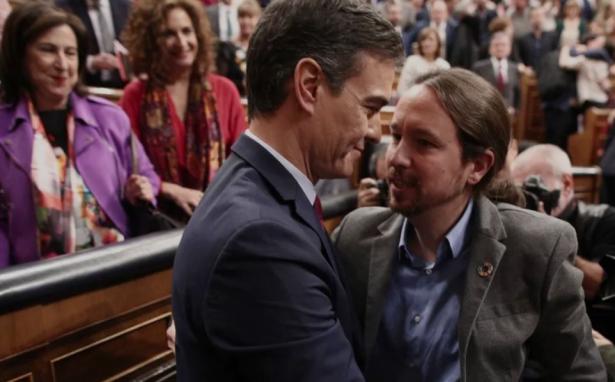
Featured image: The general secretary of Podemos, Pablo Iglesias, congratulates the new president of the Government, Pedro Sánchez, on January 7 in Madrid., Eduardo Parra / Europa Press via Getty Images // The Nation